The Art of Dealing with the Canon: From Greek Poetry to All I Want for Christmas is You
- Leonardo D'Addario
- Blog
- December 16, 2025
Ancient Greek Lyric Poetry and Music
Since I started my studies in Classical Literature, I have always loved to look for what I have been learning about the ancients in contemporary culture. I find it a good and fun exercise that, not only trains my mind to think beyond academia, but also allows me to discover that some features of Greek and Roman literature basically survived the course of time, and entered, though with some differences, the modern culture. I enjoy doing this with contemporary songs especially.
The reason is probably that my favourite genre of Greek literature has always been archaic lyric poetry. I am referring, for example, to the poems of Sappho, Alcaeus, Pindar, and so on. I love everything about them: their themes, their style, and, above all, their metrical structure, which, in most cases, is the only feature that tells us something about their now lost music. And if you are wondering, yes: these poems were accompanied by music and actually sung. In other words, they were nothing but songs, and our different perception of them is simply due to the fact that we are used to reading them in books. Therefore, it totally makes sense for me to try to search for characteristics of this ancient genre in contemporary music.
Just to provide you with a concrete example, consider the metrical structure of the great epinician songs of Pindar or the lyrical parts (στάσιμα, stasima) of tragedies, the so-called “triadic system”. The metre of these poems was organised in two strophes (strophe and antistrophe) having the same metrical pattern and a third strophe (called epode) having a different one. If the poem was very long and consisted of more than three strophes, the triad could repeat itself multiple times, always preserving, with minor changes, the same metrical structure. This basically means that, for example, the first antistrophe had exactly the same rhythm as the last antistrophe (West 1982: 47 and Martinelli 1995: 30).
Every time I explain this concept to my students, I try to make it clearer by comparing it with modern pop songs. Even though there are some differences, the principle behind the musical structure of such compositions is similar: they usually have two verses with the same music but different lyrics. An obvious difference from the triadic system is the chorus, in which music and lyrics are always the same. But you won’t be surprised at all if I tell you that certain lyrical parts of Greek tragedies also have refrains similar to modern choruses.
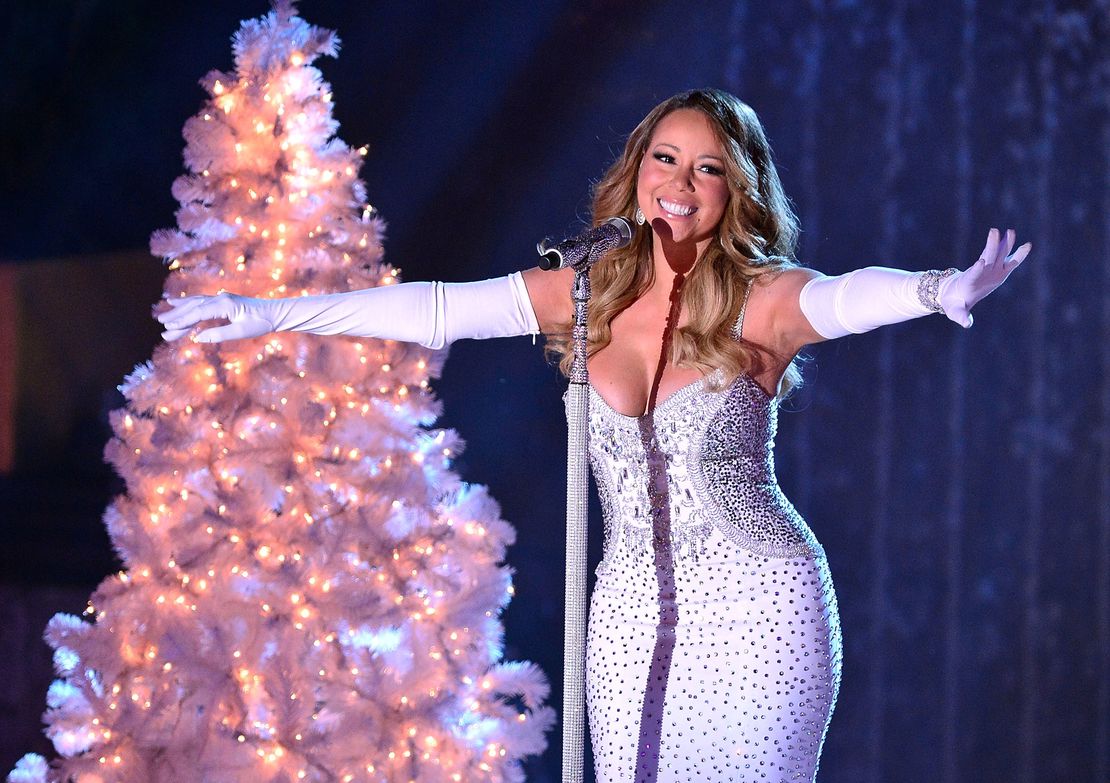
Now, you can imagine how and why I came up with the idea for this blog post. I was just curious to understand whether what I am learning about canon and canonization in antiquity is still present nowadays. And, since Christmas is approaching, is there a better time to write a blog post about Mariah Carey’s song All I Want for Christmas is You? Written in 1994 by Mariah Carey herself and Walter Afanasieff, this song keeps obtaining a huge success every year and, according to The New Yorker, can be considered “one of the few worthy modern additions to the holiday canon” (Frere-Jones 2006).
However, I will not address the questions of why and if Carey’s masterpiece actually entered the canon of Christmas songs. Rather, I will explain how its lyrics deal with this canon. Classical authors of different genres always had to engage with the previous tradition and used different strategies to claim their entitlement to be considered “canonical” themselves. For example, lost historiographers (but also poets) explicitly addressed and criticised their predecessors to highlight the originality and quality of their own historical works, while at the same time establishing continuity with the authors already considered canonical (Marincola 1997: 217-257). What is then the relationship between All I Want for Christmas is You and the canon of Christmas songs? How does this song claim its own originality and entitlement to being counted among the holiday classics?
How to deal with the Canon in contemporary times: negation as affirmation
First, let us take a look at the lyrics of the song.
Verse 1
I don’t want a lot for Christmas
There is just one thing I need (And I)
Don’t care about the presents
Underneath the Christmas tree
I don’t need to hang my stocking
There upon the fireplace (Ah)
Santa Claus won’t make me happy
With a toy on Christmas Day
Chorus
I just want you for my own (Ooh)
More than you could ever know (Ooh)
Make my wish come true
All I want for Christmas is you
You, baby
Verse 2
Oh, I won’t ask for much this Christmas
I won’t even wish for snow (And I)
I’m just gonna keep on waiting
Underneath the mistletoe
I won’t make a list and send it
To the North Pole for Saint Nick (Ah)
I won’t even stay awake to
Hear those magic reindeer click
From the very first line, the song is built around the negation and refusal of Christmas traditions and features (e.g., presents, stockings, snow), as the singer cares only about the person she loves. The structure of each verse is a progression of negations that creates expectancy in the listener, who wonders what the actual object of desire is, and leads to the chorus, which provides the answer. This rhetorical device has the effect of emphasizing the main subject of the song by comparing it with the elements listed in the verses and presented as less important through their rejection.
This discourse construction also serves as a strategy to engage with the canon of Christmas songs. The negation of Christmas traditions sounds like a refusal to sing about the conventional features one would expect in this kind of songs. From the lyrics’ perspective, the only thing actually worth singing at Christmas is the desire to stay with the loved one, rather than traditional elements such as snow, Santa Claus, and presents. In other words, the lyrics reject what is retained as “canonical” in Christmas songs and claim the superiority and originality of their own new theme. However, by explicitly and insistently refusing the canon, the singer actually ends up singing and embracing it, thus creating consistency and continuity with the tradition of Christmas songs. Adherence to the canon is affirmed by the negation of it.
How to deal with the Canon in ancient times: the praeteritio
As mentioned above, ancient historiographers also criticised and rejected the canon to establish their coherence and uniformity with it, though they employed different techniques and methods. For example, Polybius dedicated a whole book of The Histories to taking issue with Timaeus’ historiographical method, while at the same time he begins his narrative from exactly where Timaeus had left off. But this is obviously different from what I outlined above. Indeed, I noticed the presence of this discourse construction in All I Want for Christmas Is You not by thinking of some passages from Thucydides or Polybius, but rather of a lyric poem by Ibycus of Rhegium (second half of 6th BCE). Let us take a look at some sections of the text (S151 = PMG 282a lines 10-31 and 40-48):
Now [it was] my desire neither to sing of host-deceiving Paris nor slender-ankled Cassandra and the other children of Priam and the unmentionable day of capture of high-gated Troy, nor… the proud excellence of heroes whom hollow, many-bolted [ships] brought as an evil for [Troy], noble heroes; lord Agamemnon ruled them, Pleisthenid, king, lord of men, noble child of Atreus…. On these events might the skilled Heliconian Muses embark…; but no quick [mortal] man could say each one, [how great] was [the number] of ships which came from Aulis across the Aegean sea from Argos to horse-rearing [Troy], and the bronze-shielded men, sons of the Achaeans [inside]; of them, noblest with the spear… swift-footed Achilles and great valiant [Ajax] son of Telamon
[…]
…golden-girdled Hyllis bore, and to him, then, Trojans and Danaans compared Troilus, like gold already thrice-refined to orichalc, very alike in lovely form. Among them you too Polycrates, will have immortal glory for beauty forever, as according to my song and fame.
This song was intended as an encomium of Polycrates, the tyrant of Samos, who is addressed only in the very last lines. The whole poem is structured as a recusatio, that is a refusal, of the topics of the Trojan cycle. Ibycus states that he does not wish to sing about Paris, Cassandra, the fall of Troy, etc. He distances himself from the canon of epic tradition, because no man can narrate all these events. However, by stating that he does not want to narrate epic topics, Ibycus paradoxically ends up singing about them. This is a figure of speech called praeteritio (Latin: “omission,” “passing over”), and it leaves the listener wondering what the poet actually wants to sing about until the end. Here, Polycrates is finally introduced and placed on the same—if not a higher—level as the heroes mentioned throughout the poem: “Among them you too, Polycrates, will have immortal glory” (Cf. Hutchinson 2001: 235-236, and Wilkinson 2013: 55-57).
On a meta-literary level, while Ibycus is refusing the topics of the Trojan cycle in order to distance his own poetry from epic, their explicit narration reveals the poet’s claim and ability to treat them within another genre and in his own way (Budelmann 2018: 173). This becomes particularly clear when Ibycus states that “no quick [mortal] man could say each one” of these events, as he is subtly suggesting that he is the only one capable of doing so. The poem therefore shows a tension between distance from and continuity with what is already considered canonical.
Bridging the past and the present
Obviously, I do not want to suggest that Mariah Carey got the inspiration for All I Want for Christmas Is You from Ibycus. And, even more obviously, I do not want to suggest that Ibycus took inspiration from Mariah Carey. I just want to draw attention to how certain patterns can remain consistent over the ages. Even though the texts are so different and far removed from each other, the underlying strategy for engaging with the canon is to negate it in order to adhere to it: both texts refuse what is canonical yet embrace it by actually discussing it. At the same time, the use of such a rhetorical device adapts to the specific needs of each text. For example, the lyrics of Carey’s song find their originality in the addition of a new theme, superior to the traditional ones: the company of the loved one at Christmas. On the other hand, Ibycus’ poem claims that its originality lies in treating epic topics within a different genre. Nevertheless, the approach to canon is similar. And this leads to my further and more general point.
Sometimes, bridging the past and the present can make things clearer and more understandable, and can also influence how we see contemporaneity. I already mentioned that I realised the presence of this pattern in All I Want for Christmas Is You by noticing possible parallels with Ibycus’ poems. Thanks to that, I now feel that I can appreciate this song even more than before, because I am aware of the intelligent and skilful crafting behind it. At the same time, doing this sort of exercise—finding connections between antiquity and the present—has always made me realise that explaining, for example, the refutatio and praeteritio to my students can be far more engaging, fun, and effective when done through the comparison with nowadays culture. To wrap up, it seems to me that bridging the past and the present simply enhances a better understanding of both.
References
Budelmann, Felix. 2018. Greek lyric a selection. Cambridge New York: Cambridge university press.
Frere-Jones, Sasha. “On Top: Mariah Carey’s Record-Breaking Career.” The New Yorker, April 3, 2006. Archived from the original on October 13, 2010.
Hutchinson, G. O. 2001. Greek Lyric Poetry a Commentary on Selected Larger Pieces Alcman, Stesichorus, Sappho, Alcaeus, Ibycus, Anacreon, Simonides, Bacchylides, Pindar, Sophocles, Euripides. Oxford: Oxford university press.
Marincola, John. 1997. Authority and Tradition in Ancient Historiography. Cambridge: Cambridge University Press.
Martinelli, Maria Chiara. 1997. Gli strumenti del poeta elementi di metrica greca. Rist. riveduta e Corretta. Bologna: Cappelli.
West, Martin L. 1984. Greek Metre. Oxford: Clarendon Press.
Wilkinson, Claire. 2013. The Lyric of Ibycus Introduction, Text and Commentary. Berlin: De Gruyter.