Among the Paper Slips: Semantic Journeys and Canon at the Thesaurus Linguae Latinae
- Valeria Irene Boano
- Blog
- February 11, 2026
Imagine your every day office is an archive containing 10 million paper slips distributed in about 6,500 boxes. Imagine working with books enriched with the annotations of hundreds of scholars, layers of stratified information to make the research easier for whoever is coming next. Imagine contributing to a project that started more than 100 years ago and has not been finished yet.
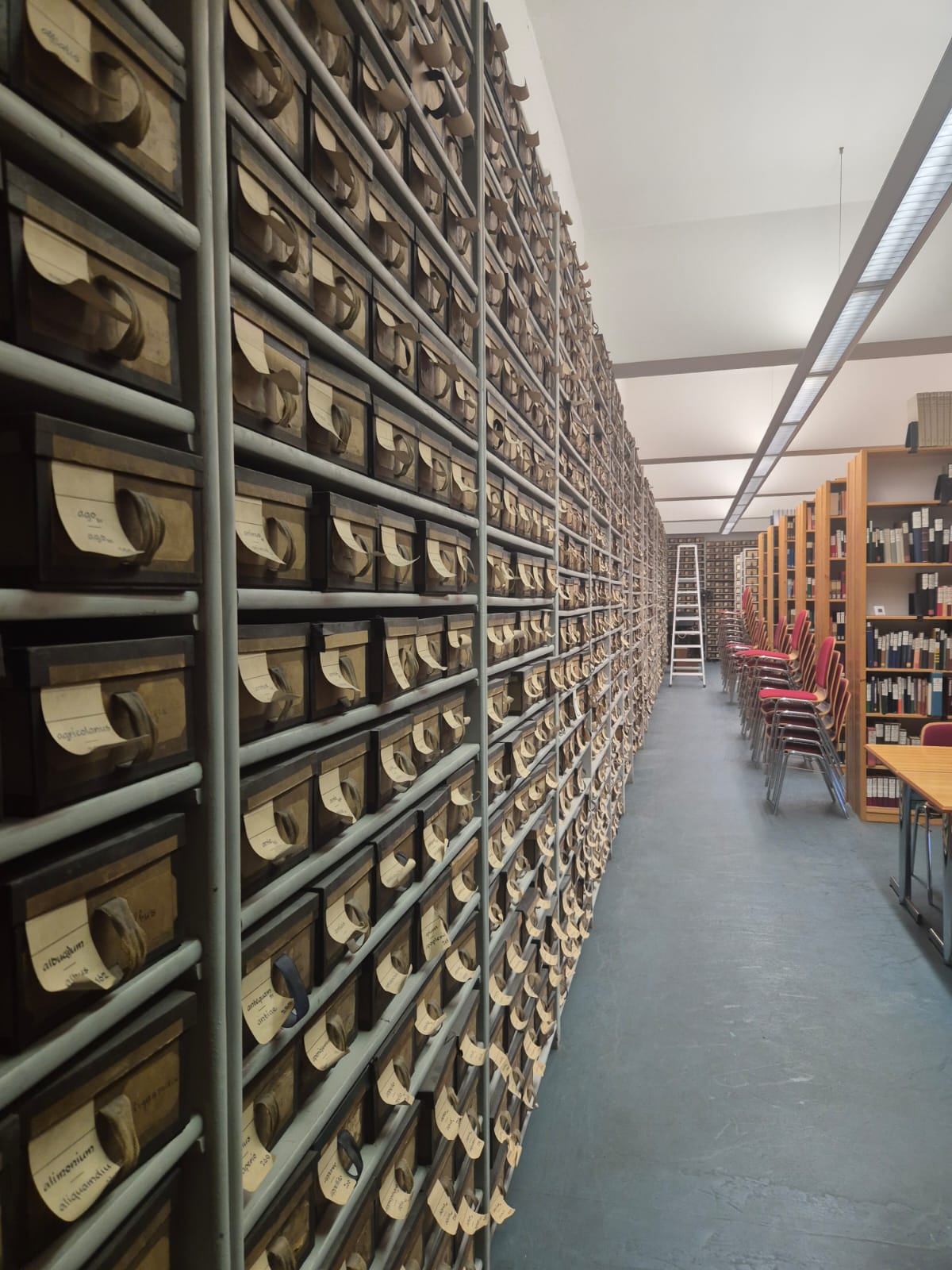 Figure 1: The TLL Zettelarchiv.
The Thesaurus linguae Latinae
Even though this may sound as something possible only in dreams, this was my experience during my MECANO internship at the Bayerische Akademie der Wissenschaften in München, where I had the chance to work at the Thesaurus linguae Latinae (TLL) from August to October 2025. The TLL is “the most authoritative dictionary of ancient Latin”, written on the basis of all extant Latin texts, produced before 600 AD. The project started at the end of the nineteenth century, with the aim of being as comprehensive as possible: every article is written by analyzing all the occurrences of each word, meticulously catalogued and constantly updated on the legendary paper slips (Zettel). These occurrences are grouped together under the same citation form, i.e. the lemma, to form the article structure (Gliederung). For each lemma, not only different meanings are recorded, but also grammatical peculiarities, etymology and comments of ancient sources. The Thesaurus is a monolingual dictionary: all the definitions are written in Latin and entries follow very strict guidelines. This choice might sound peculiar, but it reflects the dictionary’s aim of representing Latin word meanings in the most faithful way, without introducing any possible bias that modern languages might convey. The published volumes at the time of writing include the entire letter P, while both letter R and letter N are still work in progress.
The beginning: exploring a time capsule
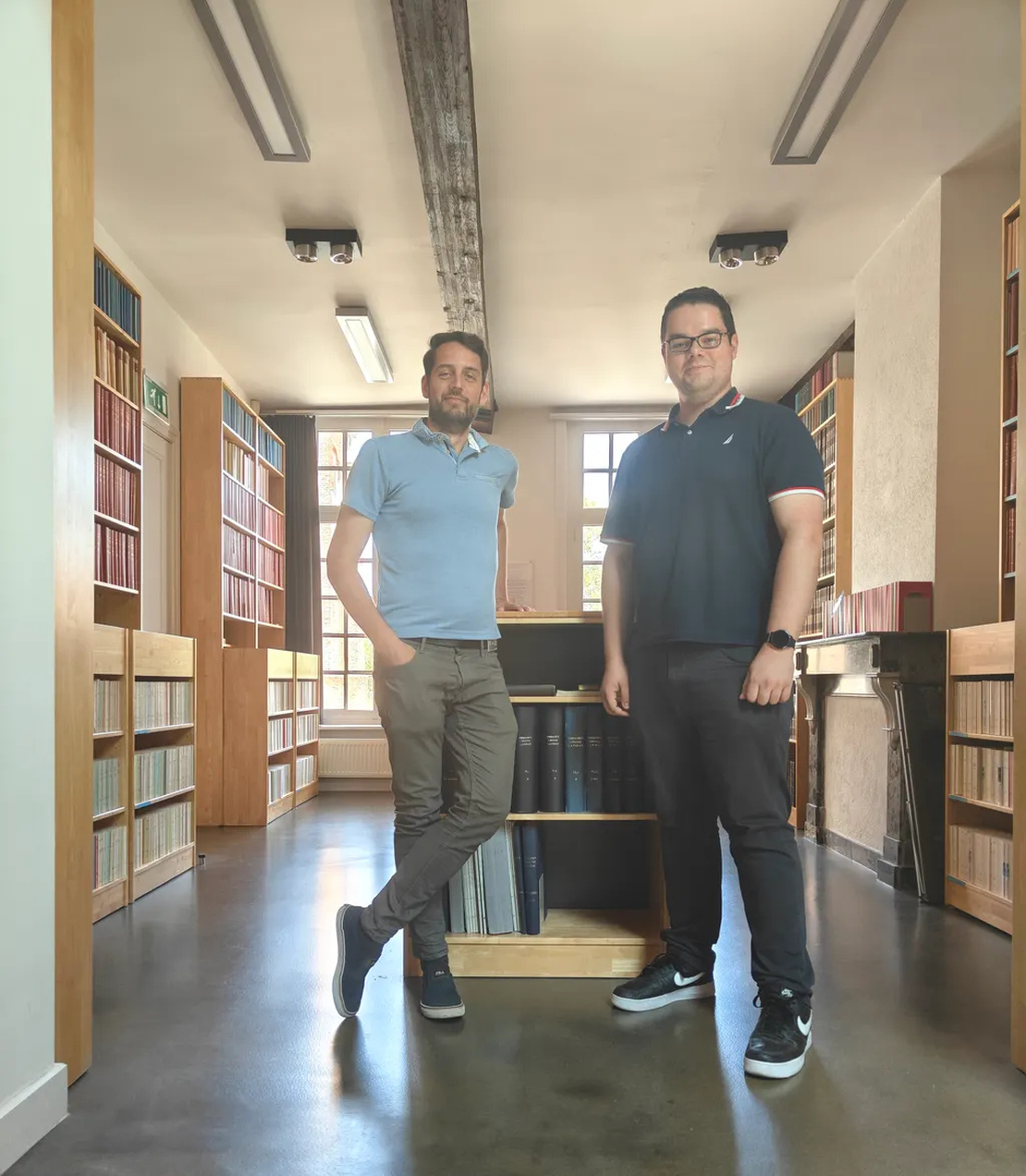
The internship started with my participation in the annual summer school, where I familiarized myself with the history and conventions of the Thesaurus, while exploring for the first time the library and the Zettelarchiv. When you enter these rooms, the feeling is that of entering a time capsule: the amount of paper and of hand written text is huge, much more so than what I had seen in years. In the library, editions, commentaries and translations for all the surviving Latin authors are disposed along the shelves, chronologically numerated. One of the first things that I noticed was that Cicero was number 10, on a list of more than 200 authors. Cicero is usually deemed to be the best representative of the “golden” Classical Latin prose and is surely not considered an archaic author: when approaching the study of history of Latin literature, several names appear before him. However, when it comes to texts that have survived the test of time, only a few of them can actually claim a place on libraries’ shelves! This was a concrete and visual realization of how unbalanced the canon of Latin texts that survived is, with the number of available books exponentially increasing century after century. It was a harsh and vivid realization about how many Latin texts are irreparably lost.
This understanding gave me a boost of curiosity about what my work was going to be like. Together with the other summer school participants, I contributed to writing the article for the lemma nummulus, “little coin”, a word with around 20 Zettel. Even writing an article for such an (apparently) simple word with so few occurrences was anything but an easy task. It made me imagine how difficult it must have been to write the article for res (’thing’), the word with the highest number of occurrences in Latin literature: to give you an idea, it took around 5 years! However, I did not feel discouraged, rather the opposite. This first sample of Thesaurus work was extremely exciting and instructive, and it equipped me with all the necessary tools for the work that awaited me in the months to come.
First, a semantic journey: working on nubecula
Soon, I was able to start working on my true first article: nubecula, “little cloud”. While savoring the beauties of München and Bavaria, between one weekend visiting the Schloss Neuschwanstein and one enjoying the Oktoberfest, I spent my days carefully examining the Zettel one by one, checking the text in the critical editions and trying to grasp the exact nuances of each textual occurrence. Curiously, the very first appearance of the term is metaphorical: the frontis tuae nubeculam appearing in Cicero’s oration In Pisonem (20) refers to the corrugated forehead of the addressee, and it is found in the middle of a nautical metaphor describing Cicero’s rescue of the res publica in the course of a storm. I found incredibly interesting how the very first occurrence of the word was clearly metaphorical, yet also contained the literal meaning, even if hidden and incapsulated into a figure of speech. The unexpected findings were not over, since I soon discovered that nubecula can also refer to various types of clots, both in medical texts, concerning different kinds of pathologies, and in other contexts, such as in mineralogy and astronomy. My surprise peaked when I discovered that nubecula could also designate a net used to catch birds. The unpredictable number of meanings hidden in this word made me aware of the semantic journeys that the researchers at the Thesaurus undertake every day.
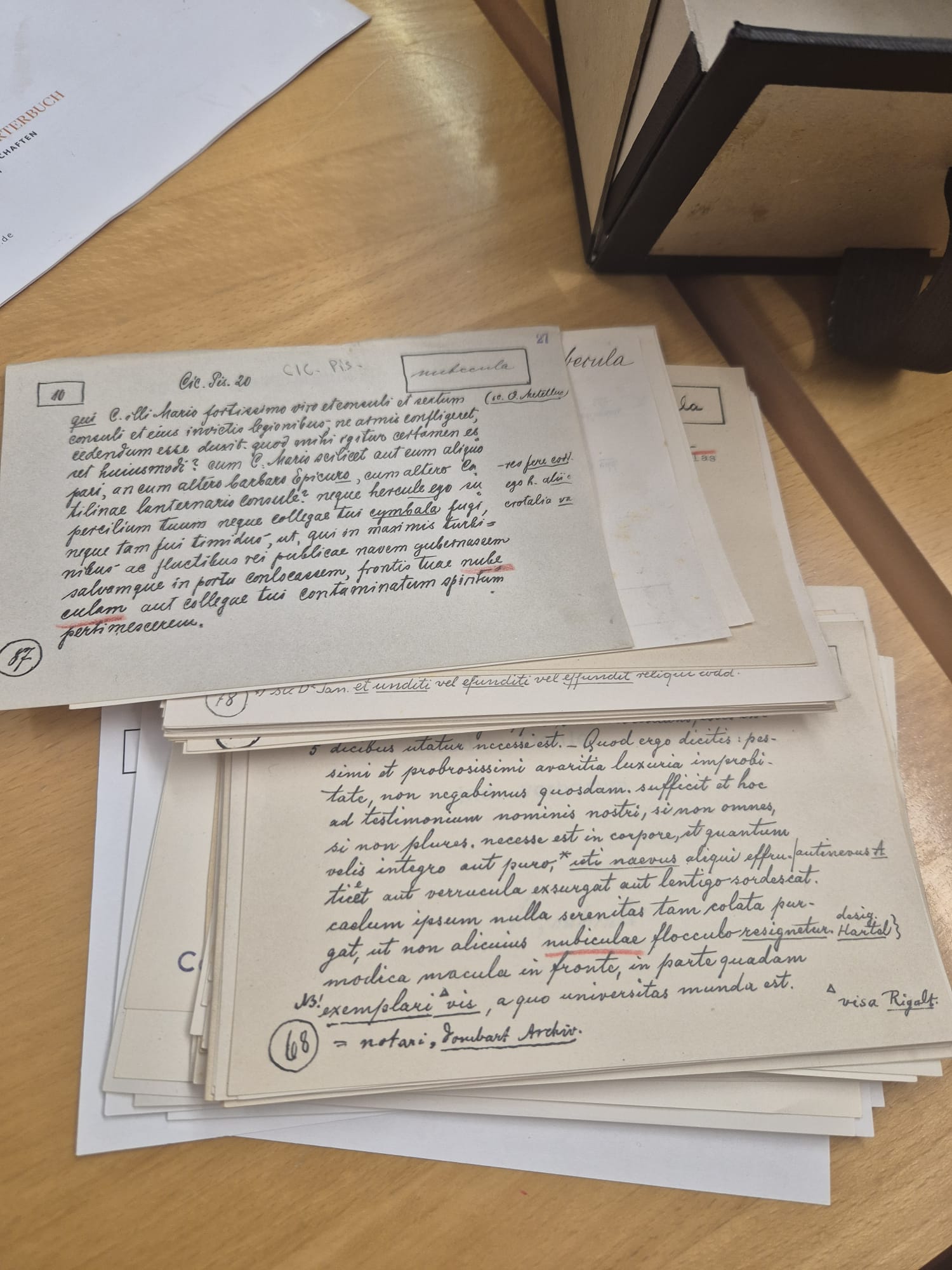 Figure 2: Some Zettel showing the occurences of nubecula.
Second, a semantic twirl: working on nugatorius
Since the experience had been so interesting, I decided to work on another lemma: nugatorius, “useless, vain”. I was ready to start a new semantic voyage, but I did not expect it to be so different. This time it was not a matter of encountering unexpected meanings, but rather of discovering that the semantics of each occurrence could not easily be categorized, encompassing different nuances of significance. The main semantic clusters related to the concept of deceit, weakness, uselessness, vanity and cheapness. However, many of the textual occurrences expressed more than one of these shades of meaning. The situation was quite different from nubecula: if in that case the meanings were very far from each other and the division between them was clear-cut, in the case of nugatorius, where the different meanings were not so distant, the semantic boundaries were very blurred. The writing of the article required several attempts, and more researchers had to be involved. This experience taught me that when you work with Latin semantics you cannot take anything for granted!
Conclusion: what the Thesaurus taught me about canonicity
Leaving München was not easy. The Thesaurus team was very welcoming and working in such a special environment was an unforgettable experience. I learned about much more than just Latin semantics. Between one semantic journey and the other, I took the chance to consider the concept of canon as reflected in the Thesaurus environment. The Thesaurus library visually reminded me of how the Latin canon, understood as the body of texts that survived to the present day, is the result of a process of selection and exclusion. However, writing a Thesaurus article showed me how inclusion is the main guiding principle of a dictionary which aspires to acquiring an authoritative status. By incorporating every word and every textual occurrence and by aiming to be as comprehensive as possible, the TLL has established itself as an authority even before its completion, serving as a guiding light for Latin scholars. The Thesaurus institution, then, embodies the interrelation between canon as exclusion and authority as inclusion, showing how canonicity is multilayered, can acquire different shapes and is far from univocal.