Supplementing the Canon
- Kendall Bitner
- Blog
- November 28, 2025
Supplementing the Canon
The MECANO project looks into what makes some texts stand the test of time while others vanish. Sometimes an important deciding factor can be the publication of editions. Not many of us, after all, bother to dig up a dusty old manuscript when we want to read something from the classical or medieval world. Much easier is it to pick up the latest edition and go from there. In my secondment at Brepols Publishers I was fortunate to get an opportunity to experience first-hand some of the decisions involved in creating these editions that we often tend to take for granted and to think about how editions—and more recently databases—continue to shape what and how we read, and what becomes canon.
A Supplemental Project
My main task during my secondment was to incorporate a collection of texts into Brepols’ Clavis Clavium and Library of Latin Texts databases. Clavis Clavium (ClaCla) is an open access database that gathers the information from many reference works on late antique and medieval Christian literature into one central resource. The Library of Latin Texts is a powerful and searchable database presenting scholarly editions of a truly staggering, and ever-growing, corpus of Latin texts.
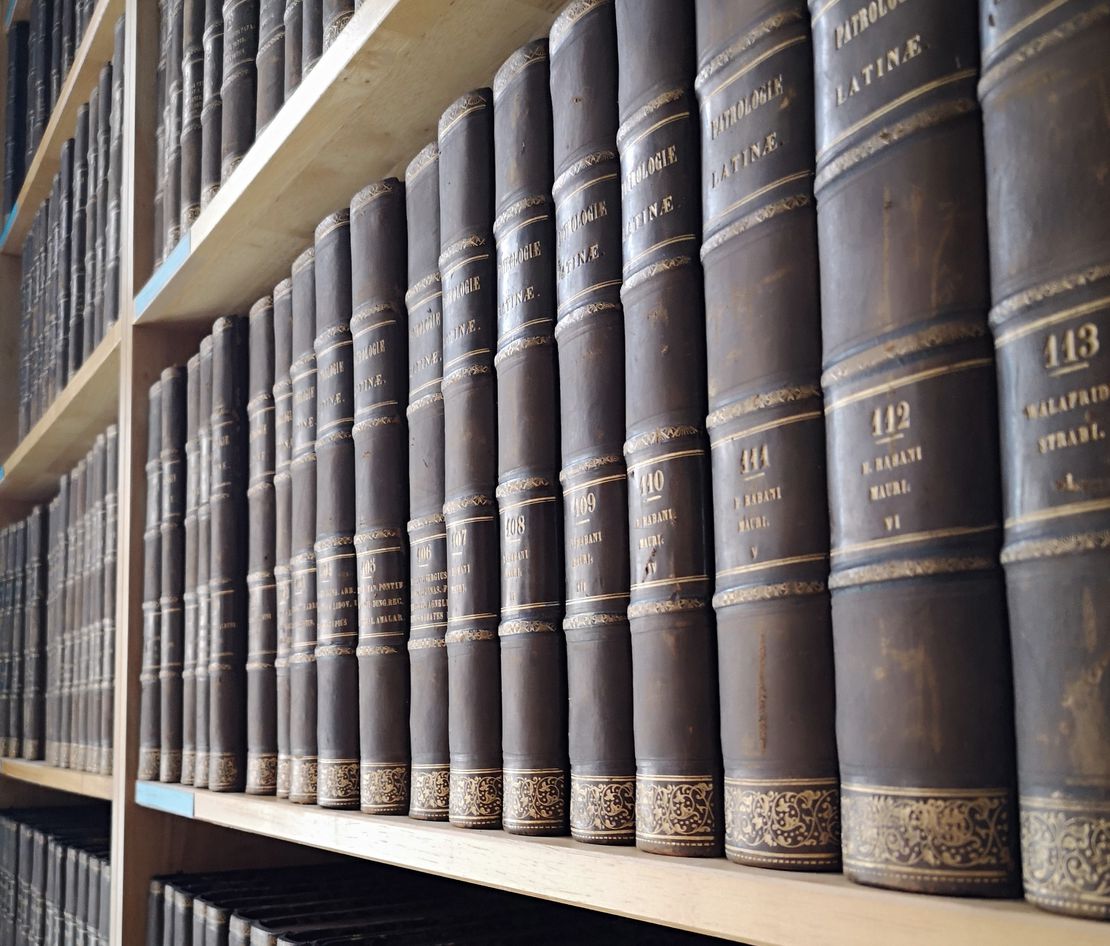
The texts I worked with were those printed in the Patrologiae Latinae Supplementum (PLS), which as the name suggests, is a series of volumes supplementing the colossal 19th-century Patrologia Latina (PL). PL itself consists of 221 volumes covering Latin Christian authors from Tertullian († 240) to Innocent III († 1216). In the words of the series editor, Jacques-Paul Migne, it is a monumentum aere perennius—a ‘monument more lasting than bronze’. The five-volume Supplementum, issued a century later, prints some 1300 texts, filling in many a gap left in the earlier series.
While some of the texts in PLS are reprints of nearly contemporary editions, many are otherwise only to be found in 16th- and 17th-century editions. If not for the PLS, these texts would be extremely difficult to access for many researchers. Even so, compared with the PL itself, the Supplementum is rather rare and obscure. Incorporating it into ClaCla and the LLT can do much to facilitate scholars’ access to the wealth of material it contains and so, perhaps, broaden the canons of those texts’ genres.
The Database as Canon
Working closely with databases such as ClaCla and the LLT has caused me to reflect on the role databases in general might have in current and future processes of canonization and the ways they might differ from traditional print resources.
Part of the appeal of databases is the promise of exhaustiveness. In some cases where a database has a relatively small and, more importantly, a rigidly-defined and unproblematic scope of material, exhaustiveness is indeed achievable. For many databases, however, such neat divisions are not possible. There are inevitably fringe cases where inclusion becomes a judgement call and there always is the possibility that material remains undiscovered or yet to be produced. In practice then, perhaps ‘exhaustive’ ought to be recast as ‘iterative’—in other words, the best way to approach exhaustiveness is to remain ever open to the inclusion of new material. This precisely is one of the advantages of the digital over print material. A printed volume has a finality to it that is absent in a database that can be continually updated with relative ease. But such flexibility comes at a price. Databases need constant upkeep not only to stay abreast of the latest research, but even to continue existing at all through the rapid changes in technology we continue to experience. This tends to be problematic given the funding structure of most academic institutions where it is new projects that are favored and already existing projects become difficult to maintain once their initial funding has dried up. On the other hand, keeping a book free from fire, water, and vermin is a relatively simple prospect.
Another promise of databases is the democratization of knowledge. They tend to promote user-directed ways of engaging with material rather than rigid top-down impositions. Multifaceted search capabilities (via the SPARQL query language, for example) and downloadable outputs in data-rich formats such as .json or complex visualizations are excellent examples of the free and creative engagement with material enabled by databases. But this, too, comes with a cost. The more complex a tool becomes, the more expertise is required to make use of it, especially if each one has its own pecularities to be learned and navigated.
What effect will databases have on how canons evolve? If we take ‘canon’ to imply not only what ought to be read, but also what in fact does get read, researched, and engaged with, an obvious prerequisite for being ‘canonical’ is the availability and accessibility of the text in the first place. The greatest opportunity I see for digital resources to influence the ongoing development of the canon is by making texts available that would otherwise be difficult for people to get their hands on. Rather than a top-down, heavy-handed challenge to the canon, it promises a bottom-up natural growth and elevation of hitherto little known texts. Of course, the likes of Shakespeare, Dante, or Homer are not likely to be supplanted, but with more and more texts becoming easily accessible, they may well be supplemented in new and interesting ways.
Digital Reflections
It is easy to forget that books themselves are a technology, and one that has seen centuries of refinement and standardization. For all our enthusiasm about the possibilities a digital turn in the humanities may open up, we are still very much in the infancy of the technology, and perhaps it will be a long while yet before digitals tools, editions, and databases become solidified and standardized as a new normal. Early printed books did their best to imitate the manuscripts of their day. Digitization of printed books occurs in much the same way, and it should not be surprising if it takes time before some kind of consensus is reached about what a digital version of a text ought to be beyond its printed counterpart. And who can tell what that will look like?