What Do You Do, Tonton?: Explaining Classical Reception to a Four-and-a-Half-Year Old
- Marin-Marie Le Bris
- April 29, 2026
How to cite: Marin-Marie Le Bris. "What Do You Do, Tonton?: Explaining Classical Reception to a Four-and-a-Half-Year Old". MECANO Blog. 29 April 2026. https://mecano-dn.eu/blog/what_do_you_do_tonton/
Whether at academic conferences and meetings, or at birthday parties and family dinners, I dread the moment when I have to introduce myself and my project. Summarising months of research into a two-minute pitch, which must be both engaging and intelligible, is a real balancing act. Yet when my four-year-old nephew asked what my job was, I decided to take the (Cretan) bull by the horns.
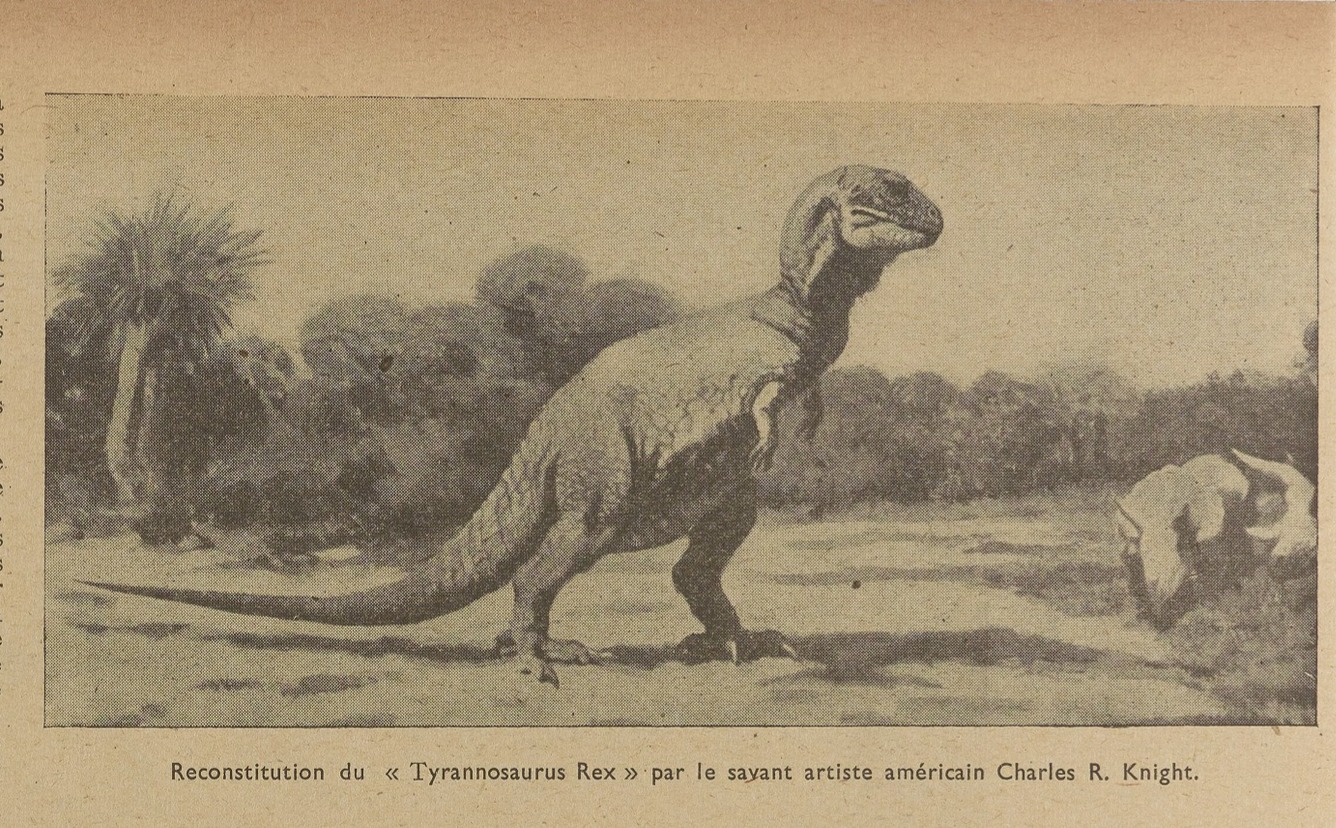 Sciences et voyages. Revue hebdomadaire illustrée, 1 January 1947, p. 8. Source: gallica.BnF.fr
Post meridiem or Absence makes the heart grow fonder
‘Il fait quoi comme travail tonton Marin ?’ asked my (then) four-year-old nephew (I shall call him M.) to my spouse (A.), last fall. What is my job? Good question. In all honesty, I am glad I was not in the room at the time, or else I fear the youngster would have been disappointed with my inability to spontaneously provide a clear and compelling answer.
Like many of my colleagues, a weekend rarely goes by where I do not either work on my research project or strive to catch up with all the other tasks I have fallen behind on (training, teaching, supervision, reporting etc.). The situation that prompted M.’s question was thus my customary absence from impromptu family reunions. Indeed, as M. wondered where ‘tonton Marin’ was on a sunny Saturday afternoon, A. had to tell him I had stayed home, to work. And since he was frustrated - as was I - by the fact that we could not play together, he was presumably curious about what could have possibly been more important to me. In truth, what I was doing was certainly not.
A. told him that my occupation consisted in ‘asking questions, trying to solve them, and then formulating new questions again’. ‘What a funny thing to do’ he must have thought - and rightly so. To a child, mine is assuredly a much less tangible profession than, say, that of a doctor or a firefighter. After all, the former cures people, the latter puts out fires - but what good is an aspiring (humanities) scholar to society?
If I had to pitch it to a fellow PhD candidate, I would introduce my project as engaging with classical reception studies, drawing on computational methods from the field of digital humanities to explore a large corpus of daily periodicals of the Third Republic (1870-1940), serving as a proxy for modern French public discourse. To an average adult (a non-academic ‘muggle’), I would say that it investigates when, why and how people in the early twentieth century referred to ancient Greek and Roman entities, be they mythological, historical or authorial. But M.’s question left me wondering whether I could offer him a more concrete sense of what I do, if I ever had to. Which is why I decided to imagine how our not-so-fictitious conversation could go.
Post mortem or All roads lead to Rome
M.
C’est quoi ton travail, tonton Marin ?
Marin
I look for traces of antiquity in old newspapers.
M.
What’s a trace?
Marin
A trace is a sign hinting at the presence of something else. As a rule, it is the evidence of something that was once present but is now only partially or barely there. Akin to when a police officer investigates a burglary: they look for clues to the thief’s prior presence, to track them down… Maybe a piece of cloth they would have inadvertently left behind, or a footprint. But the absence of something you were expecting to find can also be a clue, such as when an item has disappeared.
M.
So, you’re a policeman? Like Chase!
(Unfortunately, I am not like Chase, the ‘second-in-command’ German shepherd of the Paw Patrol (see Wikipedia ), a (very) popular animated television series. Were I a constable, I would be M.’s idol forever.)
Marin
Hmmm, not quite. I do enquire a lot, but I hardly ever catch any wrongdoers. You see, I am not so much interested in abuses as in plain uses. What I am after are the traces of antiquity in our modern world. Do you know what antiquity is M.?
M.
Ye… no. I forgot.
(M. tends to say ‘I forgot’ when, really, he means ‘I don’t know’.)
Marin
Many people use the term, but very few bother explaining what it means, what it is to them1. Maybe you’ve heard the word ancient? It designates something or someone of or from the past, because its root, ante, stands for ‘what comes before’. If you listen carefully, the root ante is also found in the word anti-quity, and what we often have in mind is ‘the actions and sayings of people who lived a very long time ago’.
M.
Like the dinosaurs!
Marin
Almost. Not that long ago, though, but many years back, yes.
M.
Like when grandpa was a little boy?
Marin
Hmmm, somewhere between grandpa’s infancy and the dinosaurs, I guess. Do you like tales of castles and knights?
M.
Yes!
Marin
Well antiquity roughly refers to the era that preceded the knights and their castles. By then, the dinosaurs had already been extinct for a while - due to the asteroid, remember? And do you know what a newspaper is, M.?
M.
No…
(Unfortunately, M. has probably never seen one of his parents read the news on paper.)
Marin
It is a bit like a magazine or a book, telling stories about things that happened yesterday.
M.
Yesterday we went to the park! Then we had ice cream. And then we went to see Grandma.
Marin
Exactly. So, the questions I am trying to answer at work are: why would one ever talk about people who lived or things that happened thousands of years ago - way before Grandpa was born - when writing a book about yesterday’s events or today’s problems? And what does this tell us of the individuals writing and reading those books and magazines, of their beliefs and ideas?
M.
…
Marin
This is starting to be a bit complicated, isn’t it?
M.
Yes tonton Marin…
Marin
OK. What’s your favourite dinosaur?
M.
The T. rex, duh!
(Duh.)
Marin
Do you know what its full name is?
(I suspect he does. M. is a child with an exceptional memory for anything that captivates him. Aside from dinosaurs, he is, for instance, surprisingly well-versed in construction vehicles and would likely pass the civil engineering course my friend D. struggled with so much during his studies.)
M.
Tyrannosaurus rex!
Marin
Wow, impressive M.! And do you know why? Is this a French term?
(Language can be a very delicate issue with M. The last time A. tried to teach him some English vocabulary while reading Michael Bond’s Paddington, M. yelled at her, infuriated: ‘Non, toi tu parle français maintenant !’ - that is, ‘No! You speak French now!’. That’s the spirit, kid.)
M.
I forgot…
Marin
The name Tyrannosaurus rex is derived from two ancient languages. It combines the expressions ‘tyrant lizard’, from Ancient Greek túrannos and saûros, and ‘king’, from the Latin rex2. The T. rex is thus ‘the king of tyrant lizards’. A bit redundant if you ask me, but the scientist who decided on its name - approximately when the newspapers I am researching were being printed on this side of the Atlantic - really wanted to convey the idea that the beast ‘greatly exceed[ed] […] any carnivorous land animal hitherto described’3.
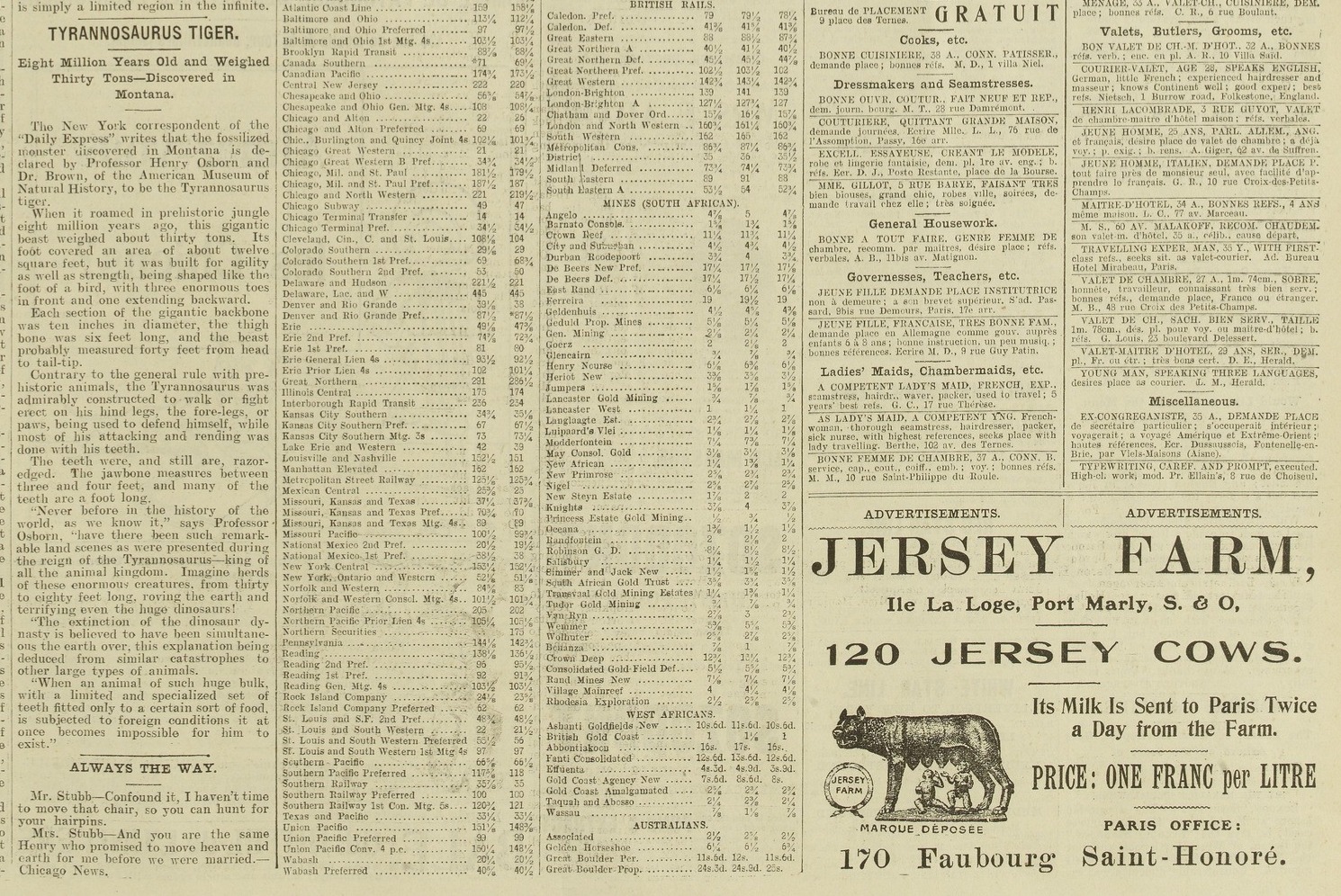 The New York Herald, 30 December 1905, p. 7. Source: gallica.BnF.fr
.
The New York Herald, 30 December 1905, p. 7. Source: gallica.BnF.fr
.
M.
But, tonton Marin, what is Latin?
Marin
It is a language that was spoken in antiquity by the inhabitants of territories ruled by the Romans. Just like the inhabitants of France now speak French. Because the Romans invaded a lot of countries, or rather lands, their language, Latin, was used over hundreds of years by many people, to communicate. To this day, Latin has served numerous purposes, such as naming dinosaurs, animals and plants.
M.
And who were the Romans?
Marin
They were a people who originated in central Italy and who then extended their dominion over most of Europe and around the Mediterranean. Our daily lives are flooded with traces of their traditions and customs. In fact, French, your mother tongue, descends from Latin! But Rome is not an empire anymore. It is now a beautiful city located south of Saint-Nazaire; that is, down from here.
(M. lives with his parents and his sister in Saint-Nazaire, a port city on France’s oceanic coast.)
M.
Is this where you and A. live?
Marin
Sadly not. I live in the Netherlands, remember? You must go up from here, way above France and Saint-Nazaire. The place has a certain charm, but I’m afraid that when it comes to food and weather, it yields to Italy.
M.
One day I will come to your house in the Netherlands. You will put balloons on the door so I can find it.
ME
I am counting on it!
M.
But tonton Marin, does my name come from antiquity too, like the T. rex?
Marin
Actually, yes M. However, I can’t be more specific in this blog post, or else there would be no point in calling you M. So, now that you have learned about it, do you want to help me with my work?
M.
Hmmm… OK.
(The time to stop swamping your nephew with information was about 400 words ago, Marin.)
Marin
Have you ever come across traces of antiquity in the books you read, in the lessons they teach you at school or in the games you play?
M.
…
(You’re clearly pushing it, Marin.)
Marin
Never mind, let’s go build the Avengers Lego set you got with A. yesterday.
Post scriptum or Reality check
In A.’s opinion, this dialogue’s Achilles heel is its lack of unanticipated and repeated - almost compulsive - whys, frequently uttered by preschool children. Luckily for me, it seems like M. has already passed the peak of this ‘why’ phase. If not, I may have to re-write the entire script.
Regrettably, dear reader, four-and-a-half-year-olds do not deal in footnotes. But since you have made it this far, you are seemingly enjoying yourself: why not peruse my brilliant colleagues’ publications too? Here are links to Valeria’s chronicles of her contributions to the ‘most authoritative dictionary of ancient Latin’ , to Timo and Kendall’s discussions of academic publishers and their role in processes of canonisation, to Doaa’s reflections on the idea of (me)kanon , to Luisa’s review of Umberto Ecco’s most irreverent pieces on literary classics , and finally, to Leonardo’s uncovering of the canonical motifs behind Mariah Carey’s iconic (lyric?) All I Want For Christmas Is You . ↩︎
No footnotes, we said. But it was kindly brought to my attention that the transliteration of the Greek τύραννος as túrannos infringes the academic convention of rendering the grapheme υ with the letter y. To the classicists reading this post: please note that my choice was primarily driven by phonetic considerations. In addition, given that I am addressing a four-and-a-half-year-old, I was wisely advised to avoid expressions such as ‘paradoxically’, ‘mental constructs’ or ‘universal medium of communication’. I am thus genuinely grateful to my colleagues Leonardo and Jonas for reviewing my piece and helping me improve it. ↩︎
One last breach of the ‘no-footnote’ policy: this attests to the American elite’s longtime taste for over-the-top labels. Calling a species the ‘king of tyrant lizards’ is a bit like calling a military operation ‘Epic Fury’, don’t you think? It would be deemed jejune by most, unless a four-and-a-half-year-old came up with it while playing on his own. Admittedly, this practice is not exclusive to the current administration: leaving geopolitical motivations aside, its mythological echo gave ‘Operation Poseidon Archer’ (2024-2025), for example, a bombastic ring. ↩︎